Guide · AuDHD in daily life

Organise daily life with AuDHD without starting over every day

A helpful daily structure does not have to be rigid or perfect. It keeps decisions, transitions and next steps outside your head—and can become smaller when less capacity is available today.

Why planning can use so much energy

A visible day often begins with invisible work.

Remembering appointments, choosing tasks, estimating time, accounting for sensory input and finding your place after an interruption can all happen before the actual task begins. When that coordination exists only in your head, it competes with everything else the day demands.
Two needs at the same time

Novelty can activate. Predictability can protect.

ADHD can seek variety and immediate stimulation while autistic needs may call for clear routines and familiar transitions. Both can be true at once. The answer is rarely maximum freedom or maximum control, but a structure with stable anchors and accepted alternatives.

Step by step

Build an AuDHD daily structure you can find your way back to.

You do not need to reorganise your whole life at once. One recurring part of the day is enough to begin.

01

Start with anchors, not a minute-by-minute schedule

Anchors are the things that are genuinely fixed: getting up, medication, an appointment, meals or sleep. They give the day a shape without assigning every hour in advance. There can still be room to move between them.

02

Write routines as observable steps

‘Get ready’ hides many decisions. ‘Brush teeth, get dressed, check bag’ makes the sequence concrete. You have enough detail when you can return to the routine after an interruption.

03

Reduce decisions before the difficult moment

Recurring questions do not need to be answered again every day. A prepared morning routine, a fixed place for keys or two accepted breakfast options can relieve more pressure than a perfect priority matrix.

04

Plan transitions as part of the task

An appointment does not begin at the time shown in the calendar. Preparation, travel, switching and recovery belong to it too. Making those transitions visible means your head does not have to calculate them in the background.

05

Define a smaller version for low-energy days

A minimal routine is not an incomplete normal plan. It is a valid version of its own: the essentials, one next step and deliberately fewer open demands.

An example, not a rule

The same morning can have two valid versions.

When enough capacity is available

  1. 1. Get up and check in briefly
  2. 2. Drink, take medication and eat breakfast
  3. 3. Get dressed and check your bag
  4. 4. Review the day’s anchors and first work step

When less is possible today

  1. 1. Drink and take essential medication
  2. 2. Put on comfortable clothes
  3. 3. Keep one unavoidable appointment visible
  4. 4. Everything else can wait

When a digital system should help

The tool should create less sorting work, not more.

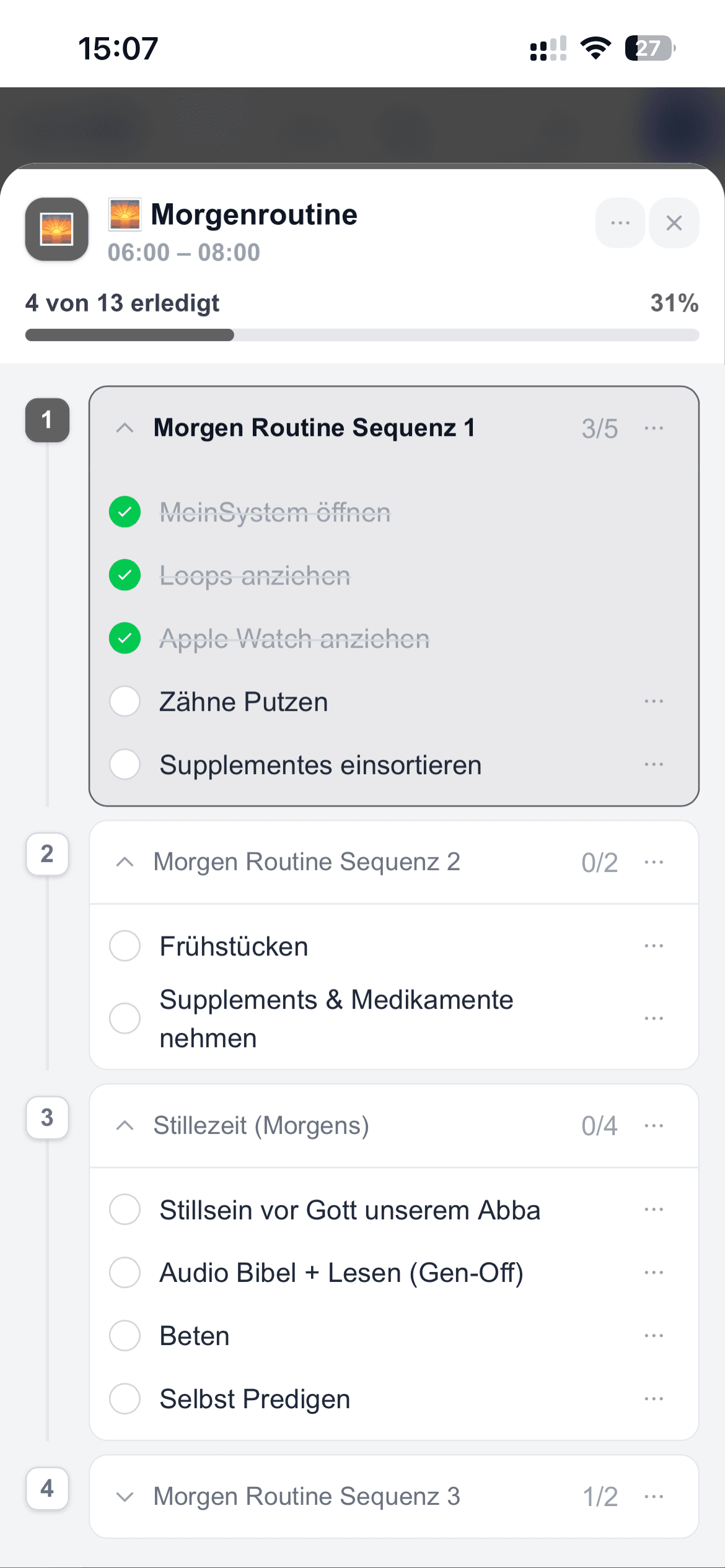
meinsystem.app brings routines, appointments and tasks into one daily flow. You can define sequences on a calmer day and later continue at the visible point without building a new priority list first.

The AuDHD planner explains this planning model in more detail. For a broader product overview, visit the AuDHD app page.

meinsystem.app daily flow for a structured day with AuDHD

Common questions

Why can daily planning with AuDHD feel so exhausting?

With autism and ADHD together, a need for novelty, stimulation and flexibility can meet a need for predictability and clear routines. Difficulties with time awareness, transitions, working memory or sensory processing can add a great deal of invisible planning work.

Do I need a fixed schedule for an AuDHD daily structure?

No. A few stable anchors, familiar routines and flexible tasks are often more helpful than a fully scheduled day. Structure should provide orientation without turning every change into a problem.

How detailed should AuDHD routines be?

Detailed enough for the next step to be understandable and for you to find your place after an interruption. More detail is not automatically better and can be hidden or combined on easier days.

What helps on difficult or sensory-heavy days?

Reduce the plan to essential anchors, physical needs and one concrete next step. Optional tasks can wait. When you are heavily overloaded, recovery takes priority over productivity.

Is meinsystem.app a medical aid for AuDHD?

No. meinsystem.app is an organisational aid for everyday life and does not replace diagnosis, therapy or individual professional support.

One routine is enough to begin

Start with a small, adaptable AuDHD template.

Open AuDHD templates