
01
What monotropism describes
Murray, Lesser and Lawson assume that attention is limited and can be distributed in different ways. They compare this to diffuse light on the one hand and a flashlight beam on the other.
A few interests, strongly held
According to the model, a monotropic tendency means that only a few interests are active at the same time, but they draw a lot of attention and feeling. A polytropic tendency, by contrast, spreads attention across many things, each of which holds it less strongly.
The attention tunnel
Inside the tunnel, a great deal is perceived; outside it, much less. A message, the time or hunger may then barely get through, even though they are objectively there. The image describes an experience, not a measured mechanism in the brain.
Switching costs more than a click
Leaving the tunnel means building up attention again and finding somewhere to leave where you were. Unexpected interruptions can therefore be especially draining. The autistic writer Fergus Murray describes this as difficulty with everything that lies outside the current tunnel.
A tendency, not a fixed type
The model describes differences in degree. In the questionnaire by Garau and colleagues, the mean score of autistic participants was 4.15 and that of non-autistic participants 3.19 on a scale from 1 to 5 – a difference in averages, not a cut-off for individual people.
02
What is supported by evidence – and what remains open
Monotropism is widespread in autistic communities. Direct research on it is young and limited in scope; the following studies show the current state and its limits.
A theoretical starting point
The 2005 article reinterprets existing knowledge rather than collecting new data. It refers to the diagnostic criteria of the time and is intended as a conceptual model for practice. It does not demonstrate that every autistic experience arises this way.
A questionnaire, not yet peer reviewed
Garau and colleagues developed a questionnaire with an autistic-led group and surveyed 1,110 people aged 16 to 78 online. Autistic participants – including self-identified ones – reached higher scores. The study is a preprint without peer review; the sample was predominantly white and highly educated.
Lab results and self-reports do not always match
Dwyer and colleagues studied 18 autistic and 22 non-autistic adolescents. In questionnaires, autistic adolescents reported more hyperfocus, but attention tasks and EEG measurements showed no group differences and no agreement with the questionnaires. The sample was small.
ADHD and AuDHD: related, but open
In an online survey of 492 adults, people with ADHD, autism or both reported more hyperfocus than the comparison group; people with ADHD without autism even more than autistic people without ADHD, although the diagnoses could only be verified to a limited extent. Monotropism itself was not measured directly there. Whether the model connects ADHD and autism is unclear.
03
In everyday life: planning with the tunnel instead of against it
The following suggestions are derived from the model and from personal accounts. They are ideas to try, not a tested method and not a treatment.
Announce switches in advance
An advance cue ten to twenty minutes before a fixed appointment leaves time to find a sensible stopping point. A specific next step is more helpful than a general demand such as “Stop now”.
Park thoughts where you can see them
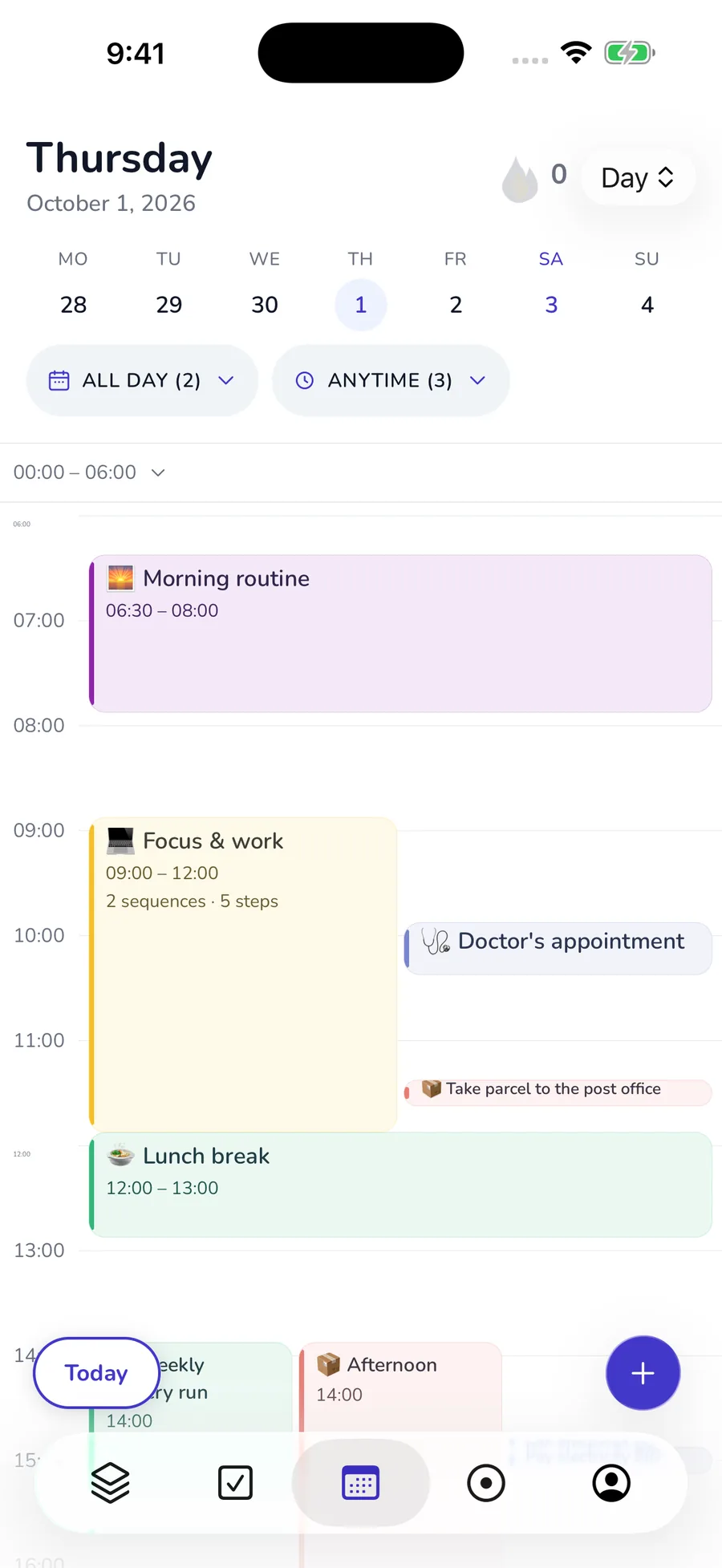
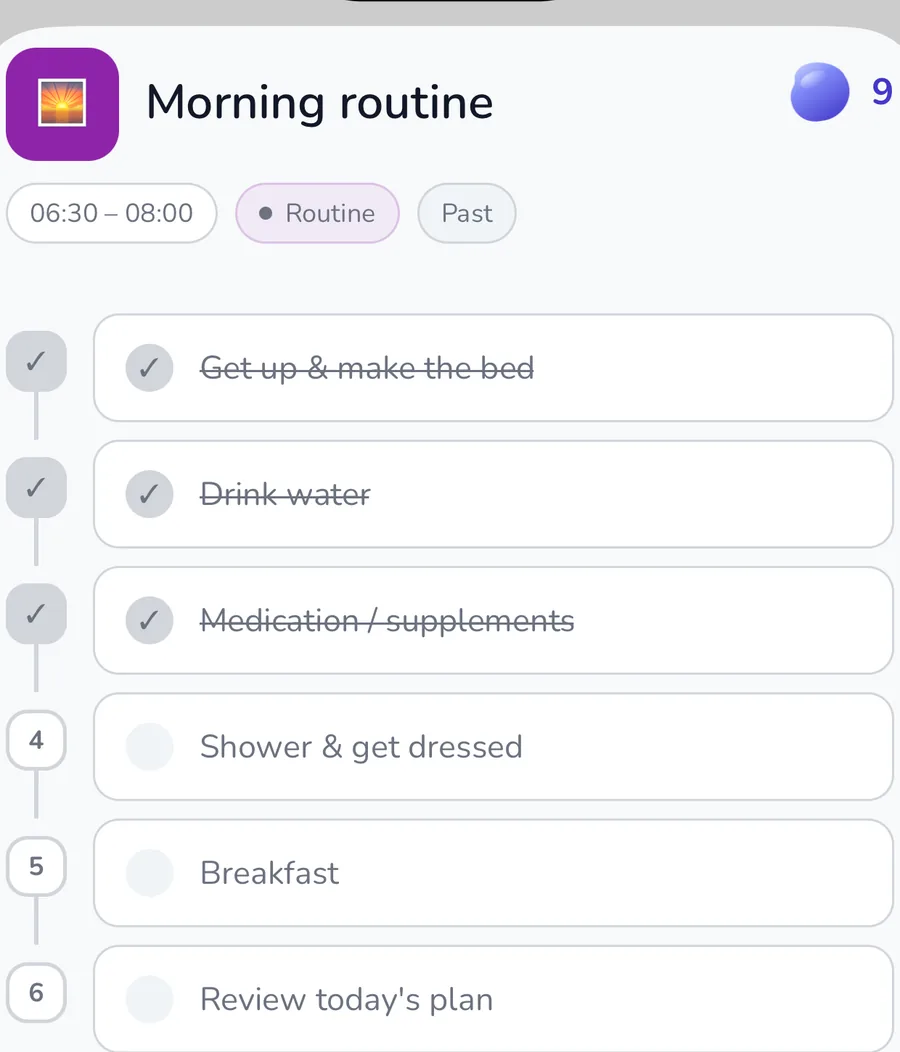
Before switching, note where you are, what is still open and what you will continue with. Then you do not have to hold the context in your head, and getting back in does not start from zero.
Make one thing at a time visible
If parallel channels take a lot of energy, a view showing only the current task can take some pressure off. Messages can be batched at set times instead of answering every interruption immediately.
Secure basic needs outside the tunnel
In interviews with 24 autistic adults, many described deep absorption as fulfilling but also exhausting, with food or sleep neglected. A drink set out in advance, a planned break and a fixed end protect focus rather than forbidding it.
A practical example
Example: from research to a phone appointment

A fictional example shows a prepared switch. It is not a rule for how attention has to work.
- Starting pointAbsorbed in research since midday; a phone appointment is scheduled for 4 pm.
- 3:35 pmAdvance cue: “Appointment in 25 minutes. Finish reading this section.”
- 3:45 pmParking note: current state, open question, next step for tomorrow.
- 3:50 pmStand up, drink some water, open the documents for the call.
- 4:00 pmPhone appointment. The research is parked visibly and ready, instead of continuing to run in your head.
- AfterwardsA short break before the research continues – or deliberately not until the next day.
Published and reviewed on · About the author
Sources for the background information
- Murray, Lesser & Lawson (2005): Attention, monotropism and the diagnostic criteria for autism ↗Theoretical journal article without its own data: limited attention, a few strongly held interests, the image of the attention tunnel. Refers to the diagnostic criteria of the time; makes no claims about diagnosis or effectiveness.
- Fergus Murray (2018): Me and Monotropism – A unified theory of autism ↗Personal essay by an autistic writer in “The Psychologist”, with a 2025 update. An experiential perspective and explanation of the model, explicitly not research evidence.
- Garau et al. (2023): The Monotropism Questionnaire (Preprint) ↗Preprint, not peer reviewed: online survey of 1,110 people, mean score 4.15 among autistic and 3.19 among non-autistic participants. Self-selected, predominantly white and highly educated sample; a research tool, not a diagnostic test.
- Dwyer, Williams, Lawson & Rivera (2024): A trans-diagnostic investigation of attention, hyper-focus, and monotropism ↗Cross-sectional survey of 492 adults with ADHD, autism, both or neither: more hyperfocus in all neurodivergent groups. Monotropism not measured directly, diagnoses only partly verifiable, no claim about causes.
- Dwyer, Sillas, Saron & Rivera (2025): Investigating autistic hyperfocus and monotropism ↗18 autistic and 22 non-autistic adolescents: more reported hyperfocus, but no group differences in lab and EEG measures and hardly any agreement between the two. Small sample.
- Buckle et al. (2021): First-hand accounts of autistic inertia ↗Qualitative focus-group study with 32 autistic adults on autistic inertia; notes an overlap with monotropism but does not test the model.
- Rapaport et al. (2024): “In a State of Flow” ↗Interviews with 24 autistic adults about deep absorption: fulfilling and at the same time hard to balance, sometimes with neglected self-care. Predominantly white, highly educated participants.