
01
What interoception covers
Besides seeing, hearing or touch, there are perceptions that come from within. Khalsa and colleagues describe interoception as the ongoing representation of the body's internal state, both conscious and unconscious.
Signals from inside the body
These include hunger and fullness, thirst, heartbeat and breathing, warmth and cold, the urge to urinate, pain or the feeling of coming down with something. The National Autistic Society names exactly these kinds of internal states as part of sensory perception.
Perceiving, interpreting, acting
A signal can arrive and still be misread – for example, hunger as irritability. It can also be recognized correctly and still be put off because something else is holding your attention. For everyday life, it is useful to look at these stages separately.
Three levels in research
In 80 people, Garfinkel and colleagues distinguished between accuracy in a heartbeat test, self-assessment by questionnaire and awareness of how accurate one's own assessment is. The three levels were only partly related. Rating yourself highly does not automatically mean doing well in the test – and vice versa.
A process, not a clinical finding
Interoception describes how perception works, not an illness. Khalsa and colleagues note that there is so far little evidence that interoceptive measures predict diagnoses, course or treatment outcomes. A single test or questionnaire therefore says little about a person.
02
Autism and ADHD: what the mixed research shows
Many studies are small, use different tests and often look only at heartbeat. The following findings show tendencies in groups, not a trait shared by all autistic people or everyone with ADHD.
Autism: no consistent pattern
A meta-analysis by Klein, Witthöft and Jungmann (2025) reviewed 31 studies. In five adult studies with 132 autistic and 134 non-autistic people, it found no significant difference in the accuracy of heartbeat perception. For children and adolescents, and for questionnaires, the results were contradictory.
Self-assessment and test results can diverge
In a small study by Garfinkel and colleagues (2016), autistic adults performed worse in a heartbeat test but rated their body awareness higher. Fiene and Brownlow, by contrast, found lower self-reported body and thirst awareness in 74 autistic adults. So the direction is not consistent.
Alexithymia as a possible factor
Shah and colleagues compared 19 autistic and 19 non-autistic adults and found no group difference in heartbeat accuracy. More pronounced alexithymia, however, was associated with lower accuracy. The samples were small; the question remains open.
ADHD: few, small studies
A systematic review by Bruton and colleagues (2025) found 18 studies. In three of five comparison studies, interoception was lower in ADHD; the two adult studies contradicted each other. All studies were snapshots, often with small groups; no cause of ADHD symptoms can be derived from them.
03
In everyday life: not just waiting for body signals
When signals arrive late or faintly or are hard to interpret, external cues can take over part of the work. These are editorial suggestions to try, not training or treatment for interoception.
Fixed anchors instead of spontaneous signals
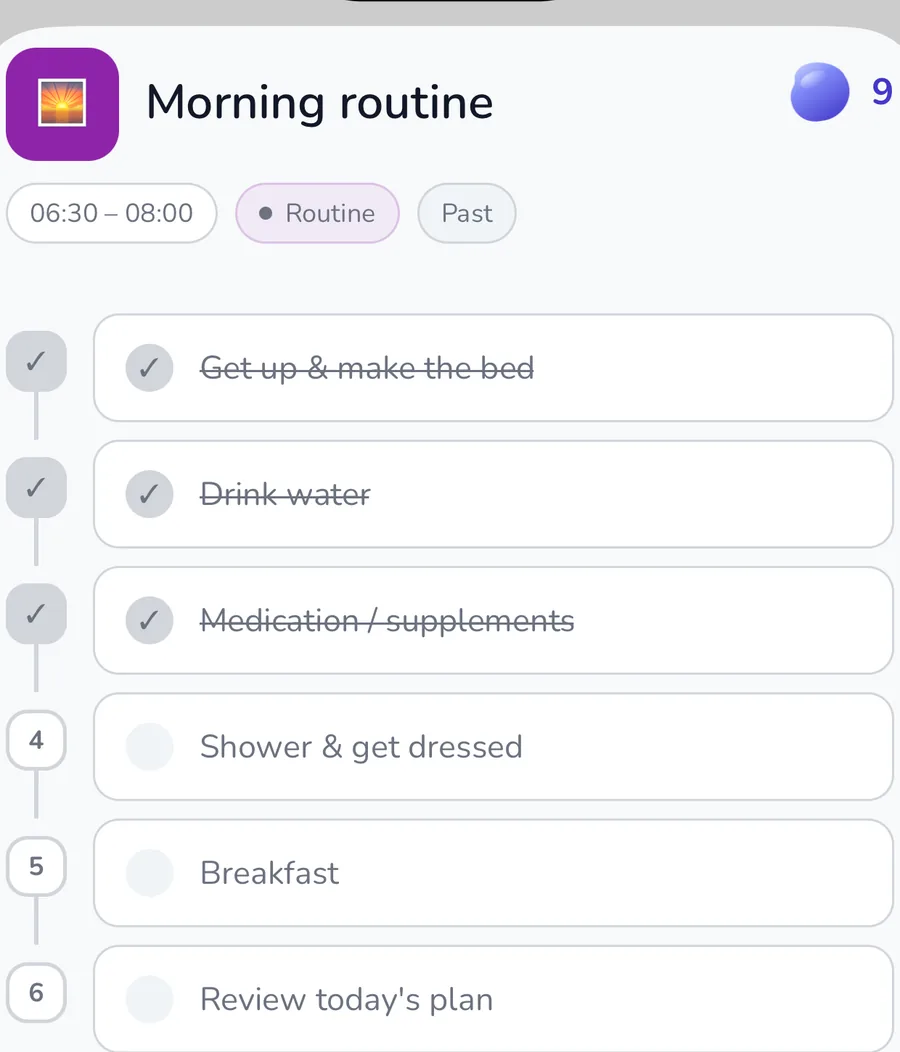
Plan meals and drink breaks by the clock or link them to recurring events, such as a glass of water at the start of each new work block. Then your body does not have to get loud first for something to happen.
A quick check at transitions
When switching between two activities, a few questions are enough: Eaten? Had something to drink? Toilet? Too warm or too cold? A short list by the door or in your daily schedule is easier than constantly tuning in to your body.
Plan long focus phases with an end
In deep concentration, body signals often fade into the background. Set an end point beforehand and have something simple to eat and drink ready, so the transition afterwards does not need planning first.
If observing is stressful or symptoms persist
If paying attention to your body increases restlessness or constant checking, drop the observing and stick to fixed times. Persistent problems with eating, drinking, pain or going to the toilet should be checked by a doctor.
A practical example
Example: a working afternoon with fixed anchors

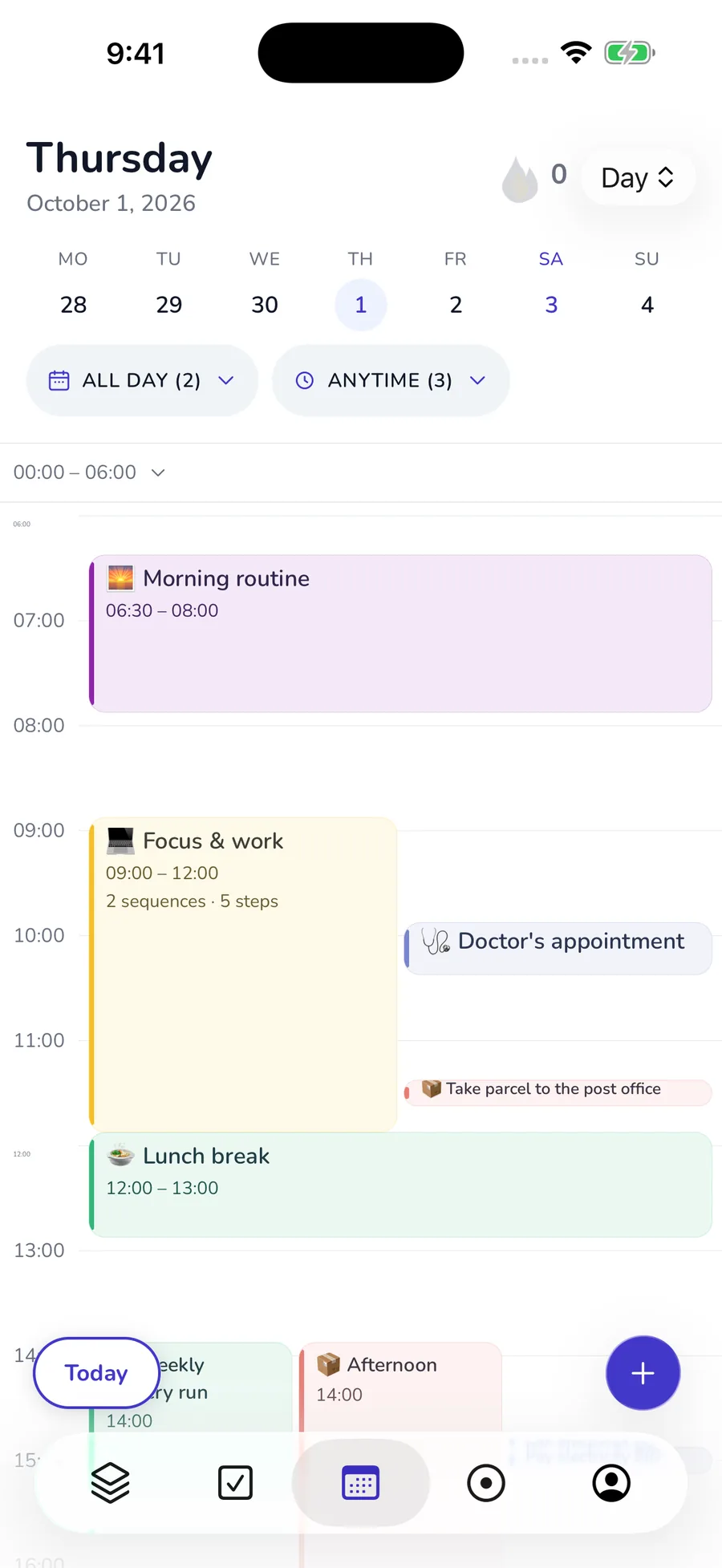
A fictional example shows how set times and transitions can complement body signals. It is not a rule and not a test of your own perception.
- 12:30 pmLunch by the clock, even without a clear feeling of hunger. Something simple is ready.
- Switching blocksBefore each new work block: refill the water glass and briefly go to the toilet.
- 3:30 pmQuick check: eaten, had a drink, warm enough, shoulders relaxed? One word per question is enough.
- Unclear signalGrowing irritability while reading is noted as possible hunger and checked with a snack.
- End of the focus blockStand up and have a drink; only then read messages.
- ReviewNote which anchor worked – without judging the day as a success or a failure.
Published and reviewed on · About the author
Sources for the background information
- Khalsa et al. (2018): Interoception and Mental Health – A Roadmap ↗Consensus paper from an expert summit: defines interoception as perceiving, interpreting and integrating internal body signals. Notes that there is so far little evidence that interoceptive measures predict diagnoses or treatment outcomes.
- Garfinkel et al. (2015): Knowing your own heart ↗Abstract: 80 people without a diagnosis; accuracy, self-assessment and metacognitive awareness as distinguishable levels. Heartbeat tasks only; no claim about autism or ADHD.
- Klein, Witthöft & Jungmann (2025): Interoception in individuals with autism spectrum disorder ↗Systematic review and meta-analysis of 31 studies: no significant difference in heartbeat accuracy in five adult studies; inconsistent results for children and questionnaires. Limitations include small samples and differing methods.
- Garfinkel et al. (2016): Discrepancies between dimensions of interoception in autism ↗Abstract: autistic adults with lower accuracy in heartbeat tests and higher self-rated body awareness. Small sample; according to the analysis by Klein and colleagues, only one of two heartbeat tasks showed a difference.
- Fiene & Brownlow (2015): Investigating interoception and body awareness in adults with and without ASD ↗Abstract: questionnaire study with 74 autistic and 228 non-autistic adults; lower self-reported body and thirst awareness. Self-report only; unevenly composed comparison group.
- Shah et al. (2016): Alexithymia, not autism, is associated with impaired interoception ↗Two small experiments, including 19 autistic and 19 non-autistic adults: no group difference, but an association between alexithymia and lower heartbeat accuracy. A single test task.
- Bruton et al. (2025): Diminished Interoceptive Accuracy in ADHD – A Systematic Review ↗Systematic review of 18 studies: lower interoception in ADHD in three of five comparison studies, contradictory adult studies, moderate study quality, cross-sectional data only.
- National Autistic Society: Autism and sensory processing ↗Accessible explanation of interoception as the perception of hunger, thirst, temperature, the urge to urinate, illness and injury. General information, not a study and not specific guidance.
- Mahler et al. (2022): Pilot study of the Interoception Curriculum ↗Abstract: before-and-after study with 14 autistic students without a control group, co-authored by the program's developer. Basis for the FAQ statement that evidence of effectiveness for such training programs is lacking.