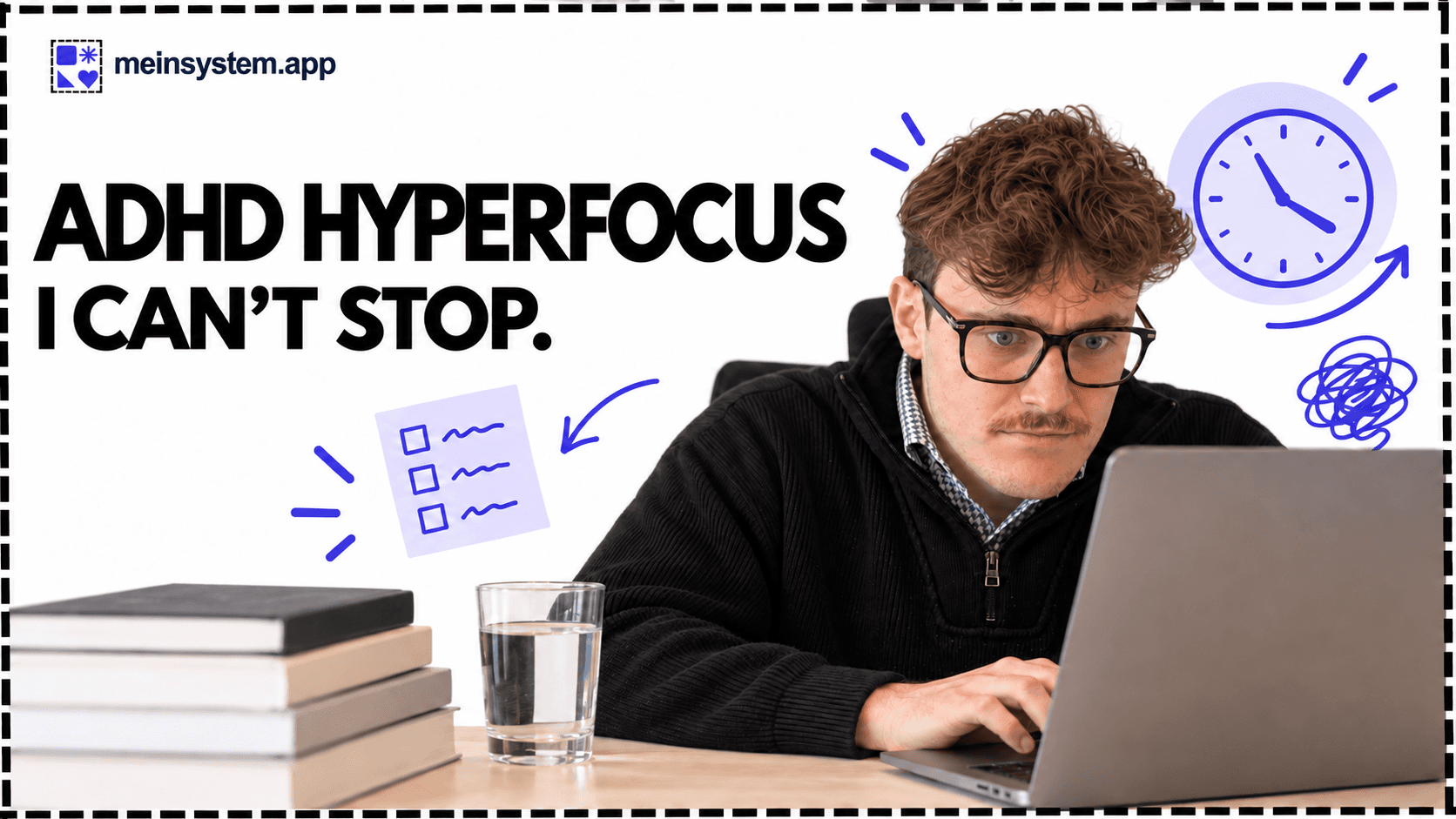

I only wanted to fix one bug.
The next time I looked at the clock, it was dark outside. My water was still untouched beside me. I had eaten nothing, missed several messages and only avoided missing another appointment because someone called me.
The bug was fixed. I had also improved three more things that nobody had planned for that day.
From the outside, that might look like impressive concentration. Working on one thing for eight or ten hours—is that not the exact opposite of ADHD?
Not for me.
The difficult part of my attention is often not that I am fundamentally unable to concentrate. It is being able to help decide what I focus on, when I focus on it and for how long. Sometimes I cannot enter a task. Sometimes I cannot leave it.
That second side is what many people describe as ADHD hyperfocus.
What ADHD hyperfocus means
Hyperfocus is not a separate diagnosis or an official diagnostic criterion for ADHD. Research also has no single agreed definition yet.
The term usually describes very intense, sustained concentration on an activity or subject. Other input moves into the background. Time, hunger, messages or tasks that are objectively more important barely reach you. The crucial part for me is that I cannot simply start or end this focus on command.
Studies of adults with ADHD describe these experiences more often in particular situations, including hobbies, screen activities or highly engaging tasks. A review of the evidence also shows how differently researchers have used the term. Hyperfocus is therefore a useful word for a familiar experience, but it is not a reliable self-test for ADHD.
People without ADHD can become completely absorbed in an activity too. Not everyone with ADHD experiences hyperfocus in the same way—or at all.
Hyperfocus is not simply good concentration
Good concentration helps me work on something important and stop again afterwards.
In hyperfocus, that control is exactly what I am missing.
I can look extremely productive while perfecting the wrong part of a task. I can work for hours and miss the one thing that genuinely mattered that day. I can become so absorbed that even signals from my body are reduced to background noise.
The result can be excellent. The process can still overwhelm me.
That is why I do not like hyperfocus being described only as an ADHD superpower. Yes, it has helped me build things, write articles and solve problems that required this depth. But an ability I cannot reliably choose, limit or leave is not simply a free advantage.
Sometimes hyperfocus is a tool.
Sometimes it is a room whose door sticks from the inside.
What hyperfocus feels like to me
At first, it often feels good.
My mind suddenly becomes quiet. The competing thoughts recede. I know what I am doing. One step leads to the next. Problems that blocked me before become interesting. I feel energy and clarity.
Then the focus narrows.
A notification appears, but it carries no weight. I see the glass of water but do not reach for it. I briefly think that I should eat soon, and a moment later the thought is gone. If someone speaks to me, it can take several seconds before their words reach me at all.
Eventually, I know that I should stop.
Knowing is not the same as being able to stop.
I tell myself: just this one section. Then I discover the next thing immediately behind it. Because the whole context is currently alive in my mind, stopping feels risky. If I leave now, I might lose the thread. So I remain inside.
The cost arrives later: hunger, headaches, irritability, disrupted sleep and other tasks left untouched. After the enormous tension, there is often a crash in which nothing works any more.
Why my mind becomes stuck on that particular thing
I cannot point my hyperfocus at my tax return whenever I choose. That would be convenient, but it is not how it works for me.
I am especially likely to slide into it when something:
- is new or surprising,
- contains a clear problem I can solve,
- interests me deeply,
- gives immediate, visible feedback,
- suddenly becomes urgent under time pressure,
- or closes an open loop in my mind.
This explains the apparent contradiction. A small, boring task can remain in front of me while I cannot enter it despite every intention. An interesting problem can make my entire surroundings disappear.
For me, ADHD paralysis and hyperfocus are therefore not opposites. Both are moments in which I have less freedom over my attention than it may appear from outside: I cannot get in, or I cannot get out.
It would be too simple to explain every episode of hyperfocus with dopamine alone. Attention arises from several factors, and research into hyperfocus remains limited. In my own life, however, I can clearly see how interest, direct feedback and urgency change my ability to enter a task.
When autism is part of the picture
I have autism as well as ADHD. That can make the tunnel feel particularly deep.
My ADHD responds to the interesting problem. My autistic side wants to understand the full context, arrange every detail and bring the subject to a logical conclusion. When both move in the same direction, I can remain inside one subject for an extraordinary length of time.
At the same time, leaving that state takes considerable effort. I am not merely switching from task A to task B. I have to dismantle one complete internal world and construct another.
I wrote more about this in my article on task switching with autism. Research is also beginning to examine hyperfocus across diagnoses, including similarities and differences in ADHD, autism and AuDHD. For my daily life, the central lesson remains that deep focus and the difficulty of switching can reinforce one another.
How I notice focus turning into a tunnel
I no longer wait for hyperfocus to feel unmistakable. By then, I am usually too deep inside it.
These are the warning signs I can recognise earlier:
I postpone basic needs. I notice hunger or thirst and still tell myself, “in a moment”.
Every ending creates a new beginning. Each completed point reveals one more thing that absolutely has to happen now.
Interruptions make me disproportionately irritable. Not because the other person did anything wrong, but because my system experiences the transition as a hard cut.
The clock surprises me repeatedly. I see 2 pm, work “briefly” and cannot believe that it is suddenly 4 pm. This is closely linked to my experience of time blindness with AuDHD.
I negotiate with my own boundaries. The timer rings and I extend it by five minutes again and again.
I cannot name the next sensible stopping point. There is only “finished”—and finished is still hours away.
One sign alone does not automatically mean hyperfocus. When several appear together, however, I do not need more motivation. I need an exit.
What helps before I disappear into hyperfocus
Making good decisions from the deepest part of the tunnel is difficult. I therefore build my exits in advance.
1. I plan the ending together with the beginning
If I only schedule “work on the article”, the task has no edge.
A better version is: “Write the first draft from 9 to 10:30 am. At 10:30, finish the current sentence, note the next step and eat breakfast.”
Stopping then becomes part of the task, not its failure.
2. The timer tells me what happens next
An alarm labelled “Stop” is easy to dismiss. An alarm that says “Get water, spend five minutes on the balcony, then decide” already contains the next transition.
That is why the meinsystem focus timer does more than help me concentrate. I use it as a visible boundary and connect its ending to one concrete next action.
3. Basic needs do not depend on leftover time
Before a longer focus block, I put water where I can see it and schedule food as a real appointment. Not “when I am finished”. I cannot reliably know in advance when finished will arrive.
When possible, I eat something first. My future self inside the tunnel is not a good negotiator for my body.
4. I need more than one signal to stop
I can easily overlook a silent message on the screen. A combination works better: sound, a visible timer and a calendar appointment. For important transitions, another person who knows I am not ignoring them deliberately can help as well.
The signal has to appear where my attention currently is—not only on a device that has already disappeared outside my tunnel.
5. I preserve the route back in
I often hold on to hyperfocus because I am afraid of losing the current chain of thought.
Before stopping, I therefore record three things:
- What have I just completed?
- Where will I continue next?
- What am I consciously allowing to remain open until then?
This small landing strip makes leaving feel safer. I do not have to hold the entire task in working memory.
6. I plan a buffer instead of a direct leap
Jumping straight from deep focus into a conversation or appointment overwhelms me. I need a few minutes in which my mind can become wider again.
Close the laptop. Stand up. Drink something. Move briefly without adding new input. Only then enter the next thing.
The buffer can look unproductive from outside. For me, it prevents me from arriving irritable and mentally half inside the previous tunnel.
My exit plan for acute hyperfocus
When I am already too deep inside, long rules do not help. I use this short sequence:
- Body first: I take both hands away from the keyboard or phone and put both feet on the floor.
- Name the time: I say out loud what time it is and when I intended to stop.
- Save the thread: I write exactly one sentence that tells me how to re-enter.
- Close the loop: I save, close the file or place the device out of reach.
- Change location: I stand up and spend at least two minutes in another room.
- Meet the need: Water, food, the bathroom, medication or quiet—the most urgent one first.
I do not debate whether I have earned another five minutes. The tunnel wins that debate almost every time.
Changing location is particularly important for me. As long as I remain in front of the same screen, the task still feels active. My body has to notice the transition, not only my calendar.
Why I built meinsystem to help me stop as well
Productivity apps usually help with beginnings: What do you need to do? What is your goal? How will you remain focused?
I also need help with endings.
That is why meinsystem.app does not separate routines, tasks, appointments and focus into four unrelated worlds. A focus block can have a visible ending. The next small action can already be waiting afterwards: eat, take a break, leave the house or begin the evening.
I do not want the app to push me towards even more output. I want it to show my mind the boundaries I cannot reliably feel from inside the tunnel.
A system does not cure hyperfocus. It can, however, place the exit outside my head—as a timer, a transition, a next step and a reminder that my day contains more than the one thing in front of me.
Hyperfocus is neither a superpower nor a personal failure
I do not want to lose my deep focus. It is part of me. I like how far I can think my way into a problem and how much it sometimes allows me to create.
I simply no longer want to pretend that every long workday was automatically a good day.
If you concentrated for eight hours but ate nothing, missed an important appointment and had no energy left for yourself, that was not simply perfect productivity. It was also not a personal failure that stopping was difficult.
The better question for me is not: How do I extract the maximum value from my hyperfocus?
It is: How do I give it a safe beginning and an ending that leaves something of me for the rest of my life?
Frequently asked questions about ADHD hyperfocus
Is hyperfocus an official ADHD symptom?
Hyperfocus is not a separate diagnostic criterion in the standard classification systems. The term does describe an experience reported in studies and by many people with ADHD. On its own, it does not establish an ADHD diagnosis.
How can I get out of ADHD hyperfocus?
Pre-planned stopping points, multiple external signals, a written route back into the task and physically changing location help me. The important part is not to wait until basic needs, appointments or sleep have already disappeared before planning the exit.
Is hyperfocus the same as flow?
The states can feel similar, but they are not automatically identical. Flow is often described as enjoyable and well matched to the task. Hyperfocus can additionally involve losing control over the subject or duration and finding it difficult to stop. Research does not yet distinguish the terms consistently.
Sources and further context
- Hupfeld, Abagis & Shah (2019): Living “in the zone”—hyperfocus in adult ADHD examined hyperfocus experiences in adults with and without ADHD across different situations.
- Ashinoff & Abu-Akel (2021): Hyperfocus—the forgotten frontier of attention reviews different definitions and shows that research does not yet use a single agreed boundary.
- Dwyer et al. (2024): Attention, hyper-focus and monotropism examines hyperfocus across autistic adults, adults with ADHD, adults with both diagnoses and a comparison group.
- Institute for Quality and Efficiency in Health Care: ADHD in adults provides an independent general overview of ADHD in adulthood.
This article describes my personal experience and general information. It is not a substitute for medical or psychological assessment.