
Some tasks feel almost immovable when you are alone.
Then somebody sits at the same table with their own laptop, and suddenly it becomes possible to open the file, answer the first email or fold the laundry. The other person does not take over. They do not supervise you. They are simply there.
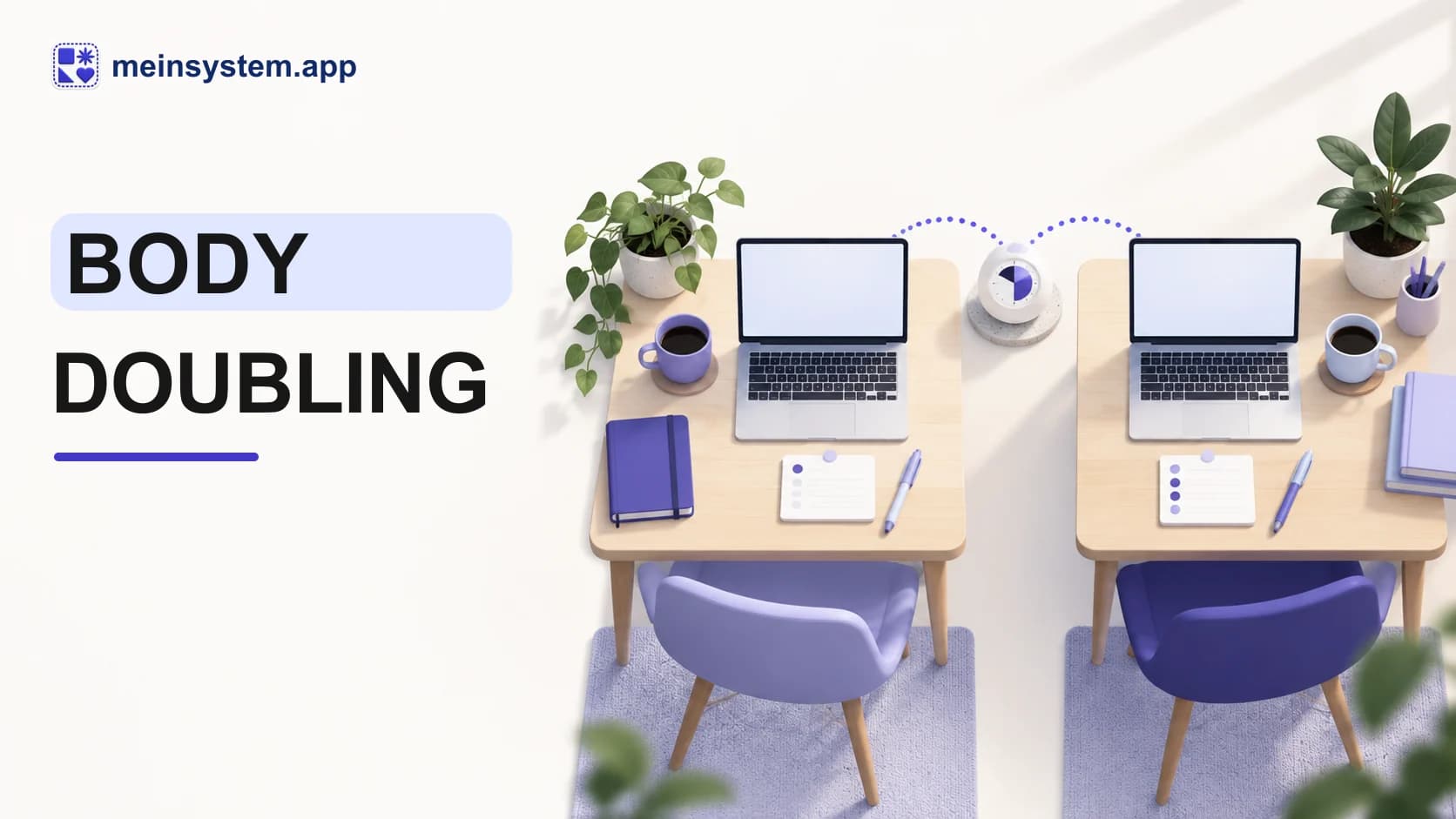
That is body doubling: doing your own task in the presence of another person. You can be in the same room, join a quiet video call or even use a “study with me” video.
For many people with ADHD, knowing what to do is not the problem. The difficult part is crossing the gap between intending to act and making the first visible movement. Body doubling can give that transition a place, a time and a calm social structure.
The short version
- In body doubling, two people work at the same time but not necessarily on the same task.
- A body double is not a supervisor and does not need to remind, motivate or assist you.
- You can meet in person, use a quiet video call, join a coworking group or work alongside recorded content.
- A clear check-in, one small task and a visible end point make the session easier to enter.
- Research is still young. A survey describes common positive experiences, but it does not prove guaranteed effectiveness.
- If another person's presence creates pressure, masking or distraction, you can change the format or decide that body doubling is not for you.
What is ADHD body doubling?
Body doubling means using another person's presence as an external frame for your own task. You might do the same activity, such as studying together, or work on completely different things. The important part is not collaboration. It is parallel presence.
A study published in 2024 asked 220 predominantly neurodivergent people how they understood and used body doubling. Their shared definition was broad: another person is present in the room, online or through media, and that presence helps someone start, stay with or complete a task.
After reading the definition, 75 per cent of respondents said they used body doubling. Some had relied on the strategy for years without knowing its name. That finding is interesting, but it is not proof of effectiveness: participants selected themselves, and the study did not compare body doubling with other methods in a controlled trial.
Body doubling is best understood as a community-developed strategy you can test, not as a treatment and not as evidence that somebody has ADHD.
Why can another person's presence help?
Adults with ADHD may experience difficulties with organisation, time management, staying on task and completing larger projects. Body doubling does not remove those difficulties. It can, however, move part of the structure out of your mind and into the environment.
The task receives a real starting point
“I will do my taxes today” remains easy to move. “We will meet at 10 a.m. for 25 minutes, and I will open the receipt folder first” has a time and a visible first action.
If that exact transition is blocked, the detailed guide to ADHD paralysis and difficult task initiation may help you understand the experience more clearly.
The other person becomes a quiet cue
You do not have to keep reminding yourself that you intended to work. Parallel activity remains visible in the room. Survey participants described accountability, reminders, motivation, comfort and companionship among the helpful aspects.
That does not mean social pressure is always useful. A good body double creates enough presence to keep the task visible without adding so much observation that you feel controlled.
The task is no longer tied to being alone
Unpleasant or unclear tasks can feel isolating. Another person does not have to solve the problem for the moment to feel less lonely. That quiet parallel presence can be useful for housework, paperwork, studying or long computer tasks.
Start body doubling in 10 minutes
You do not need a platform, a perfect method or a long introductory conversation. This is enough for a first experiment:
- Choose one task. Not “clean the flat,” but “take the dishes to the kitchen.”
- Name the first visible movement. Open the file, fetch the laundry basket or place the document on the desk.
- Ask somebody for ten minutes of parallel presence. Meet in person, by phone or on video.
- Each say what you will do. One sentence is enough. Advice is not required.
- Set a visible end point. Work for ten or 25 minutes, then genuinely pause.
- Close with one sentence. What did you finish, and what would the next step be later?
You can create a bounded work block with the free visual focus timer. If the task is still too large, first use Break a task into small steps.
Four ways to use body doubling
1. In the same room
One person answers emails while the other sorts paperwork. You do not need to talk or work on the same project. A library, kitchen table or office can be enough.
This format offers the clearest sense of presence, but noise, movement or social tension can also make it too intense.
2. A quiet video or audio call
Check in briefly, mute, work, then close the session. The camera can help, but it does not have to be on. An audio-only call may take less energy for some people.
Virtual body doubling is particularly useful when travel, energy or different locations make an in-person meeting difficult.
3. A small coworking group
Several people name their tasks and work quietly for a fixed period. A recurring group can provide consistency when individual friends are not always available. At the same time, a large group or frequent conversation can fragment attention again.
4. Recorded or indirect company
The study also describes videos, livestreams and working in public places as forms of body doubling. A “study with me” video or a calm café is not identical to an appointment with a person, but it can still create a sense of parallel activity.
If live interaction uses too much energy, this version may be worth trying.
How to ask someone to be your body double
The term sounds more complicated than the request needs to be. For example:
“I am stuck on a task. Do you have ten minutes when we could both quietly work on our own thing? You do not need to help me – your presence is enough.”
Or for a video call:
“Would you like to work online together for 25 minutes tomorrow at 9? We can each name our task, stay quiet and stop on time.”
A good invitation includes the duration, format and expectation. The other person then knows that they are not being asked to coach or supervise you.
What rules make body doubling more comfortable?
- No unsolicited coaching. The body double does not continually ask for progress or judge the result.
- A clear ending. An open-ended call can turn support into another demanding obligation.
- The camera is optional. Visibility may help, but it is not proof of productivity.
- Breaks are allowed. Getting water, moving or restarting is not failure.
- Discuss privacy. Screens, paperwork and conversations may contain personal information.
- Either person can stop. If the format is not working today, the session may end without a defence.
These boundaries matter particularly when work already demands a lot of social adaptation. The article about ADHD at work and the invisible cost of performance looks more closely at interruptions, expectations and masking in the workplace.
Which tasks are a good fit for body doubling?
Household tasks were the most common activity in the survey. Participants also mentioned studying, professional work, writing, exercise and leisure activities. In practice, body doubling can be useful for tasks that:
- are boring or repetitive,
- have no natural starting time,
- feel emotionally unpleasant,
- contain many small decisions,
- easily disappear from view when you are alone,
- are difficult to resume after an interruption.
That means body doubling can be useful for paying bills, studying or folding laundry. For complex decisions, however, another person's presence does not replace appropriate professional help.
When body doubling does not help or makes things harder
Not every mind works better when another person is present. Possible difficulties include:
- You monitor the other person more than your own task.
- You feel judged and begin to mask.
- Conversation becomes the new distraction.
- The task contains confidential information.
- The appointment creates more pressure than direction.
- You stay focused for too long and miss breaks.
You can change the duration, person, camera or medium. Perhaps a café works better than a call, a recorded video works better than a person, or a timer works better than any social presence.
A body double should also respect the end of deep focus. The guide to ADHD hyperfocus and the difficulty of stopping explains why a helpful beginning does not automatically create a healthy transition out.
What if nobody is available?
You can recreate useful parts of the method without pretending that a recording is identical to a human being:
- work for a defined block in a library or calm café,
- use a quiet “study with me” or “clean with me” video,
- send a trusted person your mini-task beforehand and only “done” or “stopped” afterwards,
- schedule a short recurring session instead of asking from scratch each time,
- combine a visible timer with a prepared first action.
The perfect version is not the goal. What matters is finding the form of external structure that returns more energy today than it costs.
Body doubling, coworking and accountability: What is the difference?
The ideas overlap, but their emphasis differs:
- Body doubling: Parallel presence is the support. Interaction can remain minimal.
- Coworking: People share a place or session, usually with a broad productivity goal.
- Accountability: Somebody expects a report or checks whether an agreed result was reached.
- Collaboration: Several people work towards the same result.
Body doubling can include accountability, but it does not have to. If being monitored makes the block worse, explicitly agreed quiet presence may be the better fit.
Frequently asked questions about ADHD body doubling
Does my body double need to have ADHD?
No. It matters more that the person respects the format: few interruptions, no unsolicited judgement and a clear time frame. Some people feel better understood by another neurodivergent person; others work well with a calm friend, colleague or group.
Does the camera need to be on for virtual body doubling?
No. Video can make the other person's presence more visible, but it can also create stress. Audio, chat, livestreams or a shared timer can provide an external frame too.
Is body doubling scientifically proven?
Not yet in the sense of large controlled effectiveness trials. Current research describes how neurodivergent people define and use body doubling. It documents common positive experiences, but it does not establish for whom the method reliably works or whether it is superior to other strategies.
Is body doubling an ADHD treatment?
No. It is a practical self-management strategy and does not replace assessment, psychotherapy or medication. If attention, organisation or task initiation difficulties significantly affect your life, professional support is appropriate.
Can I try body doubling for free?
Yes. A trusted person, a library, a quiet call or freely available companion video is enough for a test. You only need to pay if you deliberately choose a moderated or commercial service.
Sources and further context
- Eagle, Baltaxe-Admony & Ringland (2024): An Investigation of Body Doubling with Neurodivergent Participants describes definitions, formats, tasks and experiences from a survey of 220 predominantly neurodivergent people. It examines use, not clinical effectiveness.
- National Institute of Mental Health: ADHD in Adults provides context on possible difficulties with organisation, procrastination, time management, daily tasks and larger projects.
This article offers general information and practical ideas. It is not a substitute for medical or psychological advice, and body doubling is not a replacement for ADHD treatment.