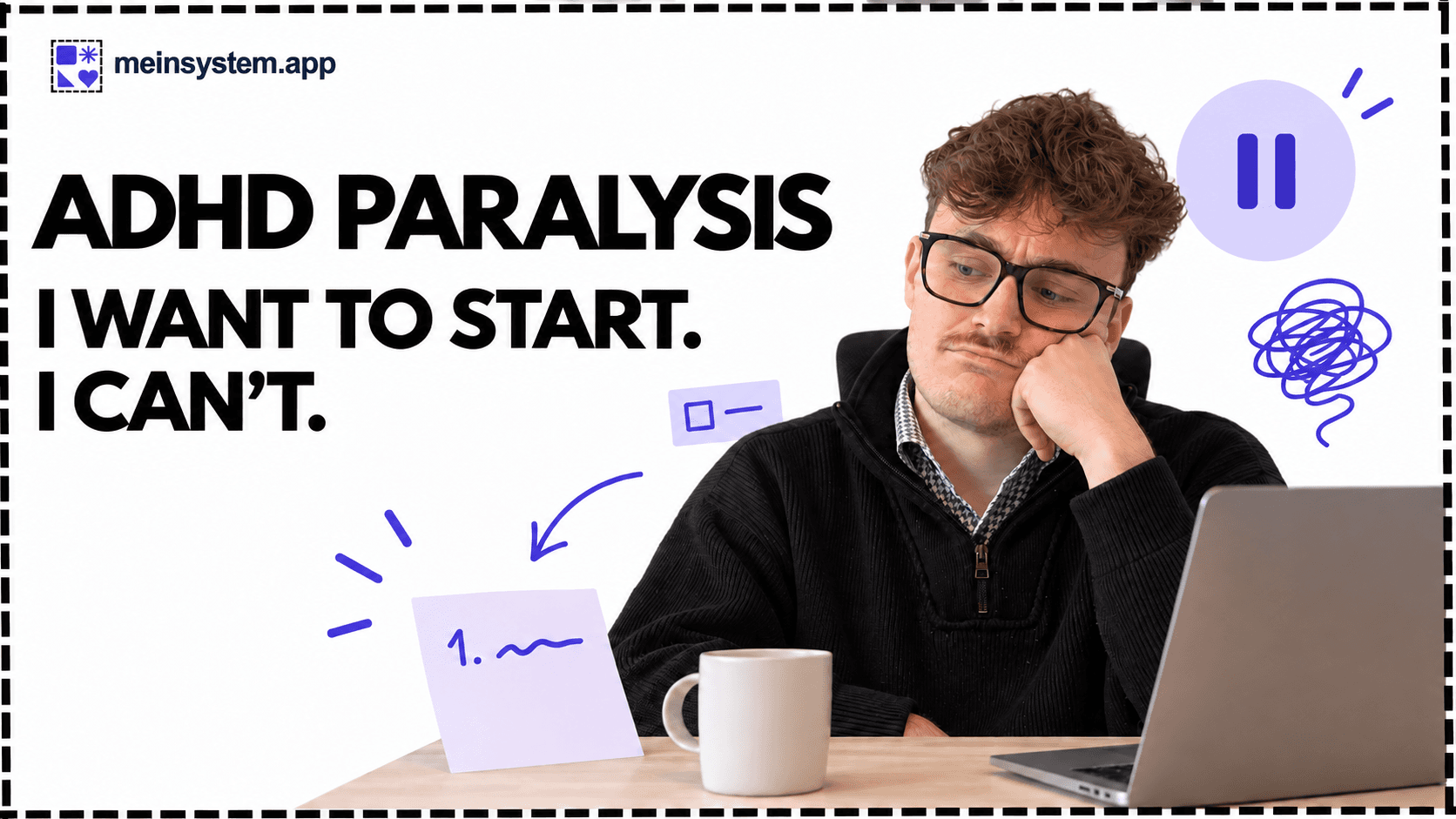

The task is open. The cursor is blinking. I know exactly what I need to do.
And I do not do it.
I sit at my desk, stare at the screen and feel the pressure rise with every minute. I might quickly check my email. I might look at my phone. I might research something that is only loosely connected to the task.
From the outside, it looks like procrastination.
From the inside, it feels as though there is an invisible wall between the thought and the first movement. I want to begin. The task matters to me. Sometimes I even enjoy it once I am inside it. But the start simply does not happen.
Many people with ADHD call this state ADHD paralysis or task paralysis. I knew the feeling long before I had a name for it. Back then, I had a different explanation:
I am lazy. I am undisciplined. Apparently, I do not want it enough.
I see it differently now.
What people mean by ADHD paralysis
ADHD paralysis is not a separate medical diagnosis. It is an everyday term for a state in which you want to begin or decide but remain stuck.
It can look different from one situation to another:
- You sit in front of a task and cannot enter the first step.
- You have five things to do and cannot select any of them.
- You remain stuck in another activity even though you intended to switch long ago.
- You think about the task continuously while doing something completely different.
- You do nothing and are still not relaxed.
That last point matters to me. ADHD paralysis does not feel like leisure. I am not recovering. The task keeps running in the background and taking energy while I make no progress.
Research tends to use terms such as difficulties with attention, self-regulation, planning, organisation or procrastination. A recent systematic review found a consistent association between ADHD symptoms and procrastination across several studies. Inattention showed the most robust relationship. However, the studies do not prove that every delay connected with ADHD has the same cause.
The community term ADHD paralysis therefore describes a real experience. It does not replace a diagnosis or automatically explain every moment in which someone puts something off.
What the block feels like for me
Sometimes it begins in bed.
My alarm rings. I know I need to get up. At the same time, my mind immediately starts planning the entire day. Brush my teeth first or get dressed? Eat breakfast or prepare my supplements? Which appointments do I have? What did I forget yesterday?
There are too many first steps, so none of them happens.
Then I reach for my phone because the phone requires no entry point. A feed immediately gives me something new. I do not have to plan, sort or tolerate a decision. Half an hour later, I am still lying there and feeling ashamed because the day has already begun in the wrong way.
It can look similar at my desk. I can see ten tasks and understand why each one matters. An invoice. A bug in meinsystem. A message. A video. An appointment I need to prepare for.
My problem is not missing knowledge. My problem is the transition from I know to I am doing the first visible step.
Why “just start” does not help
The sentence sounds logical. It also describes the exact function that is not working.
Starting is not a single button. My mind has to do several things at once:
What matters now? What is the first step? How long will it take? What happens afterwards? Do I need to prepare something first? What am I leaving behind if I select this task?
When all those questions remain open, “deal with the invoice” is not one task to me. It is a blurred block of ten possible actions. Find the invoice. Check the amount. Write a question. Open online banking. Transfer the money. Save the receipt.
My mind sees the whole block and cannot find a handle.
A longer to-do list does not solve this. It only shows me more precisely how many things I am currently not starting.
Why important tasks can become especially difficult
For a long time, I thought that something should be easier to begin if it genuinely mattered to me.
The opposite often happens.
The more important a task is, the larger it becomes in my mind. Expectations attach themselves to it. I have to do it correctly. I must not forget anything. The result has to be good. If I start now, I will probably have to finish it too.
One email suddenly becomes a test of my entire competence.
If I have been stuck on similar tasks before, shame arrives at the desk with me. Before I begin, I already hear: you will fail again. You have lost too much time. Now it has to be perfect, at least.
This pressure sometimes creates enough activation just before a deadline. I then work through everything in a sprint. But the price is high: stress, hyperfocus, forgetting food and water, and feeling completely empty afterwards.
The fact that deadline panic eventually moves me does not make it a good system for daily life.
When autism is part of the picture too
I have autism as well as ADHD. That makes beginning difficult in a second way.
My ADHD becomes lost in possibilities. My autistic side needs a clear, predictable sequence. When that sequence is missing, my mind wants to understand the entire task before it releases the first step.
Beginning is also always a transition. I have to leave the state I am currently in. From bed to the bathroom. From breakfast to my desk. From a message into concentrated work.
Those task transitions with autism take energy from me. When I am resting, moving into action is difficult. When I am in hyperfocus, leaving it is difficult. The block can therefore sit in front of the task or in front of the transition required to reach it.
That is what makes AuDHD feel so contradictory to me. One part seeks the quick new stimulus. Another part does not want to leave the current state.
What makes my ADHD paralysis worse
I can now recognise a few reliable patterns.
The task is phrased too broadly. “Do my taxes”, “clean the flat” or “finish the website” contains no visible beginning.
Too many tasks appear equally important. When everything has priority, I cannot select anything.
The time is vague. “Later today” gives my mind no start. This is closely connected with my experience of time blindness.
The transition arrives without warning. An interruption or sudden change removes my internal run-up.
The task carries shame. The longer I delay it, the more threatening it feels.
My system is already overloaded. Hunger, thirst, noise and too many open thoughts turn a small hurdle into a wall.
This also means that every block does not need the same response. Sometimes clarity is missing. Sometimes energy is missing. Sometimes I need less sensory input. Sometimes the real first step is making the task smaller for today.
What genuinely helps me begin
I no longer try to push myself through the wall with more pressure. I try to build a lower wall.
1. The first step must be physically visible
“Deal with the invoice” is too large.
“Open the email containing the invoice” is something I can do.
“Clean the kitchen” is too large.
“Put one cup in the dishwasher” is something I can do.
The first step is allowed to look almost ridiculously small. It does not need to impress the task. It needs to create movement.
That is also why my morning routine with ADHD does not begin with “start the day well”. It begins with putting my feet on the floor and opening meinsystem.
2. I decide the entry point in advance
Selecting the perfect task while blocked demands the exact function that is currently failing.
I therefore choose the next step at a moment when my mind has more capacity. I decide not only what I will do, but also when and how I will begin.
Not: “Work on the article tomorrow.”
Instead: “9 am. Open the document. Write the first subheading.”
The decision is not gone forever. But it no longer sits in the exact moment when I am already stuck.
3. A timer gives the task a boundary
Sometimes the beginning itself is not blocking me. I am afraid I will not be allowed to stop afterwards.
Then I set a timer for five or ten minutes. This is not a trick with a hidden expectation that I will continue for three hours. I am genuinely allowed to stop when the timer ends.
A defined period turns an endless task into a manageable experiment. The meinsystem focus timer is visible and bounded for exactly that reason. It helps me enter and later reminds me to leave again.
4. I show myself only one thing
A list of twenty open tasks does not help me when I am paralysed. It is additional input.
I do not need a perfect overview in that moment. I need the next step.
I therefore try to put routines, appointments and tasks into a sequence. Not everything at once. What is due now can remain visible. The rest does not have to disappear, but it does not need to look at me at the same time either.
5. I leave a route back in
Stopping is easier when I know how I will start again later.
Before leaving a task, I write one sentence: “Next, test the button in the mobile layout.” Or: “The reply is complete. Check spelling and send.”
The next work session no longer begins in front of a blurred mountain. My earlier self has already marked the entry point.
6. There is a minimum version
On difficult days, I need a version smaller than my ideal.
Not the whole morning routine. Only brushing my teeth, taking medication and eating something.
Not cleaning the flat. Only taking out the rubbish.
Not finishing the article. Only saving three bullet points.
A minimum version is not giving up. It prevents “not completely” from automatically becoming “not at all”.
My emergency plan when nothing is moving
When I notice that I have stared at the same task for twenty minutes, I try this sequence:
- I name the state: “I am stuck right now.” Not: “I am lazy.”
- I write down everything that is demanding attention in my mind at once.
- I choose exactly one task and describe only its first visible movement.
- I reduce input. Phone away, notifications off, Loop earplugs in if it is noisy.
- I set five minutes and allow myself to decide again afterwards.
This does not work every time. It is not a button that switches ADHD off. But it gives me a route back that is smaller than “pull yourself together and finally finish everything”.
If you want to try this plan, do not begin with the task you have feared for six months. Test it first on something small. Open one message. Move one plate. Name one file.
The plan should show your mind that entry is possible. It does not have to prove that you can tear down every wall immediately.
Why I built meinsystem this way
I did not build meinsystem.app because I am particularly good at organising myself.
I built it because I cannot organise on difficult days.
I divide routines into steps once. Appointments receive a concrete time. Tasks stay in one place. In the day view, I see not only what matters at some point, but what is due now.
On a good day, I decide. On a difficult day, I do not have to begin again from a blank page.
That does not solve every moment of ADHD paralysis. Sometimes I am tired, overstimulated or emotionally blocked and need something other than an app. But meinsystem removes at least some of the questions that otherwise stop me before the first step.
You still want to, even when you are not starting
If you are sitting in front of a task and cannot move, that moment says nothing about your character.
Something can matter to you and still be difficult to begin. You can be motivated and still become stuck. You can know exactly what to do and still need support for the transition into action.
Do not make the task larger by fighting yourself as well.
Do not search for enough pressure to move the entire mountain. Search for the first handle.
Open one file. Put your feet on the floor. Make five minutes visible.
The beginning does not need to do more than that yet.
Frequently asked questions about ADHD paralysis
Is ADHD paralysis a medical diagnosis?
No. ADHD paralysis is a widely used everyday term, not a separate diagnosis. It describes the experience of becoming stuck when beginning, deciding or switching despite intending to act. If these difficulties significantly affect your daily life, professional assessment may be useful.
Is ADHD paralysis simply procrastination?
The terms overlap but are not identical. Procrastination describes delay. ADHD paralysis describes the subjective experience of being unable to find an entry point despite an existing intention. Not every delay is caused by ADHD, and every block does not look the same.
How can I get out of ADHD paralysis?
Reducing input, writing down competing thoughts and translating the task into one visible movement help me. A short timer and genuine permission to stop afterwards can also give the start a boundary. If the block is persistent or severely distressing, a blog article is not a substitute for professional support.
Sources and further context
- National Institute of Mental Health: ADHD in Adults discusses difficulties with organisation, procrastination, time management, daily tasks and larger projects.
- National Institute of Mental Health: ADHD - What You Need to Know includes breaking large tasks into smaller steps as one possible form of practical support.
- Suriano (2026): Systematic review on ADHD and procrastination found a consistent association across eleven studies while also noting methodological limitations and the inability to draw causal conclusions.
- Cleveland Clinic: What Is ADHD Paralysis? explains the community term and distinguishes it from medical paralysis or a separate diagnosis.
This article describes my personal experience and general information. It is not a substitute for medical or psychological assessment.