
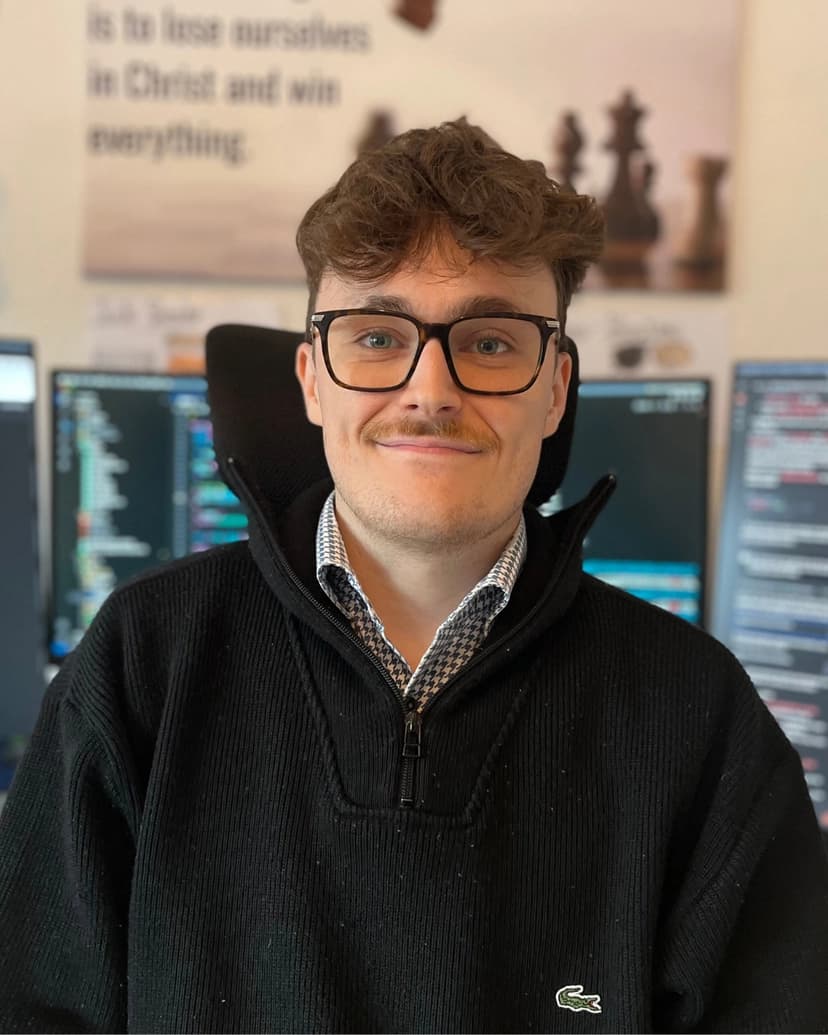
Christian faith with AuDHD: why you are not a bad Christian
I left my church congregation this year.
For a long time, I thought that made me a bad Christian.
Not because my faith had disappeared, but because alongside work, housework and everything else life brings, I simply could not manage it any longer.
I know exactly what the feeling afterwards is like:
“I am a bad Christian because I cannot take part in everything.”
Perhaps you know that thought too.
If you do, this is the first thing I want to tell you:
You are not alone, and none of this makes you a bad Christian.
I am writing from personal experience. I have AuDHD, the combination of autism and ADHD. Many things considered normal in church life take several times more energy for me.
For a long time, I thought the problem was me.
Today, I believe the problem is a brain that functions differently and expectations that were often not designed for such a brain.
Sensory overload is not weak faith
Sunday is not a problem with your faith.
The noise. The smells. The light. The small talk. Having to smile.
Being asked “How are you?” for the hundredth time and answering “fine” when nothing is fine.
For me, that can be unbelievably exhausting.
I am already tired from the week, and Sunday can feel like the final stone added on top.
There have been many Sundays when I simply could not go.
For a long time, I thought that was a spiritual problem.
Now I see it differently.
It is not weak faith. It is a brain that has been operating at its limit all week and eventually has nothing left.
If you believe in Jesus, you are his child. That does not depend on how much charge your battery has on Sunday morning.
Sensory overload is not weak faith.
The shame of being different
Perhaps you know this feeling: everyone else appears to live their faith without difficulty.
They attend church on Sundays. They serve in the congregation. They read their Bible regularly. They seem spiritually steady.
And you wonder why the same things are so hard for you.
Why you need two days to recover after an event.
Why you sometimes cannot follow a sermon.
Why you forget prayer requests.
Why community often feels more like work than rest.
That shame can become incredibly heavy.
But shame is not a measure of your faith.
People usually see only what is visible from the outside. God also sees the energy it costs you. He sees the struggles no one else sees.
Community on a smaller scale
I still believe community matters, but it needs to happen in a setting that works for you.
For me, that is a small home group.
Honestly, even that often requires a sacrifice. Every time, I consider whether I still have enough energy to go.
The difference is that the people there know I have AuDHD.
If I need to leave early because I am completely drained, I can simply say so. It is all right. I do not have to mask there.
That is the key for me: a place where you do not have to perform a version of yourself all evening that does not really exist.
This home group has now become my church community.
Honestly, I find that picture closer to the origins of the church than much of what we call church today. The first Christians met in homes, in small groups and in the middle of daily life.
When I invite people now, I say directly:
I cannot prepare anything. If something is on your heart, bring it with you.
Every time, we end up with a richly filled table.
You are not too sensitive for community. You may simply need a form of community that fits your nervous system.
Prayer is a relationship, not an appointment
When someone asks me to pray for them today, I often answer immediately:
I will pray for you here and now, or I may forget.
That removes the pressure.
If that feels too direct, you can also say:
I will pray for you when I remember.
Then you do not have to feel guilty if it does not happen immediately.
A fixed 30-minute prayer session every morning can be counterproductive for many people with AuDHD.
I talk to God throughout the day, spontaneously, whenever something is on my heart.
To me, that reflects a relationship better than a perfect calendar entry.
It is a relationship, not an appointment.
Reading the Bible without turning it into a law
An audio Bible helps me enormously. I listen and read along at the same time. Without the audio, it is incredibly difficult for me.
I have given it a fixed place in my day, but I have stopped turning that practice into a law.
To be completely clear:
You are not a bad Christian if you do not read the Bible every day.
God speaks to us through the Bible, and that is valuable.
But God also speaks through people, nature, conversations, art and thoughts.
If you encounter God more readily in a forest than in a perfect reading plan, that does not make you a worse Christian.
Rules that do not make sense
When a rule makes no sense to me, I find it difficult to follow.
I believe that is all right.
God gave you a mind. You are allowed to use it.
Asking questions is not disobedience. It is part of an honest relationship.
Passages in the Bible can be interpreted in different ways, and much needs to be understood in context. Anyone who claims there is always only one possible reading often makes things too simple.
God is not looking for puppets. He is looking for people.
Stand fast therefore in the liberty wherewith Christ hath made us free, and be not entangled again with the yoke of bondage.
Galatians 5:1 (KJV)
Anxiety, compulsions and therapy
Unfortunately, anxiety, compulsions and periods of depression are not uncommon alongside AuDHD.
I struggled with compulsions and anxiety for a long time. Topics such as hell, sin or the end times can intensify them when your mind is already prone to spirals of fear.
For God hath not given us the spirit of fear; but of power, and of love, and of a sound mind.
2 Timothy 1:7 (KJV)
It helps me to remember that God did not give us a spirit of fear, but one of love.
If a thought continually makes you smaller, more hopeless and more paralysed, it is worth questioning whether that thought truly comes from God.
And I want to say this without qualification:
Therapy is not a lack of faith. Medication is not a lack of faith. Seeking help is not a lack of faith.
God and professional support do not exclude each other.
Saying no is not a sin
I used to take on an enormous amount at church.
Help here. Serve there. One more meeting. One more task. One more appointment.
Until eventually, nothing worked at all.
Today, I know:
God does not need your burnout.
He does not need an exhausted version of you. He does not need someone who destroys themselves for him. He does not want you burnt out; he wants you whole.
Saying no is self-care, and self-care is not a sin.
Your boundaries are not a weakness. They are an honest measure of what is currently possible.
Come unto me, all ye that labour and are heavy laden, and I will give you rest.
Matthew 11:28 (KJV)
What truly matters
With AuDHD, you often feel like the greatest failure already.
So I want to say this as clearly as I can:
Your worth before God does not depend on how well you function.
God does not accept you because you manage to be a good Christian. He accepts you because you are his child.
That has already been decided—not through your performance, but through what Jesus did.
On bad days when nothing works, you are just as much his child as you are on good days. Your forgetfulness, tiredness and limits do not change that.
Behold, what manner of love the Father hath bestowed upon us, that we should be called the sons of God.
1 John 3:1 (KJV)
If you need to hear this today:
You are not a bad Christian.
You are a Christian with AuDHD.
There is a difference.
You do not have to be the Christian other people expect. You are allowed to be the person God made you to be.
With AuDHD. With your limits. With your different brain.
None of that separates you from him.
And you are not alone.